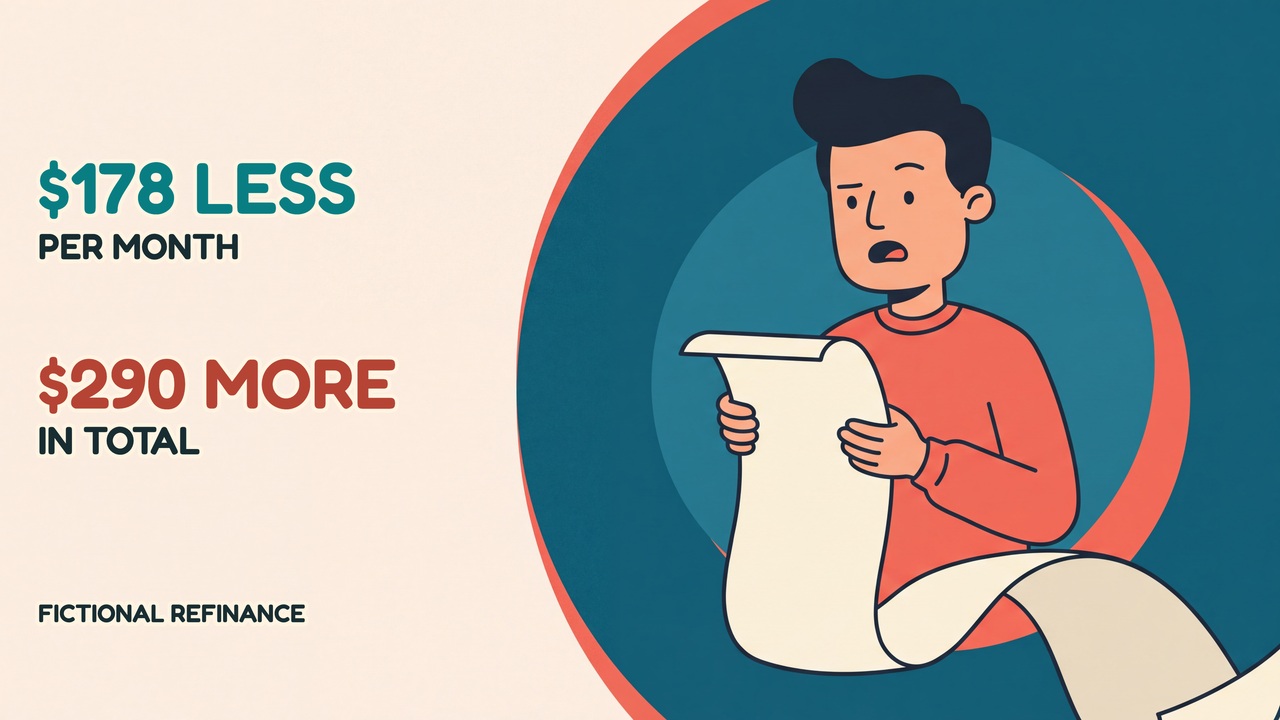
Lower Loan Payment, Higher Total Cost? The Refinance Check
Compare monthly payment, total future cost and the debt-free date before refinancing. A worked example shows why a lower rate and payment can still cost more.
 fiscal
Finance videos / Borrowing & housing
Mortgages explained for beginners: principal, interest, equity, repayment periods and the housing costs beyond your monthly loan payment.
Video in English
Loading this player sends connection and viewing data to Google/YouTube, which may use cookies or similar technologies. The rest of this page works without it.
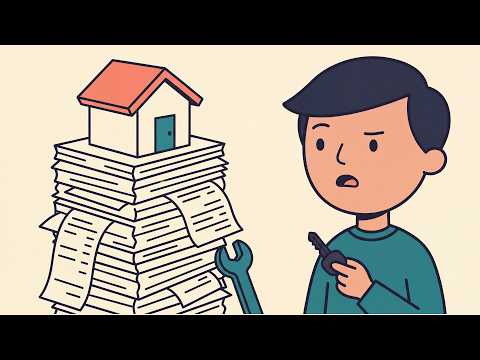
Privacy detailsAlex can afford the mortgage payment. Has the roof approved his calculation?
A country-neutral guide to understanding mortgages with Alex, Maya, Leo, Nina and Ben. Learn what you borrow, how principal and interest work, what equity means, why a longer repayment period can cost more in interest, and why the loan payment is only part of a housing budget.
This episode explains general concepts, not one country's mortgage system. Dollar amounts are invented teaching examples, not US-specific guidance, market quotes, or recommended loan terms. Local laws, contribution requirements, taxes, fees, interest calculations, renewal rules and typical loan structures vary. A fixed-rate period may be shorter than the repayment period. Some structures leave principal outstanding.
ILLUSTRATIVE MATH Home price: $300,000. Upfront contribution: $60,000. Borrowing: $240,000. The contribution shown is not a universal minimum.
For the worked example only, assume a fully amortizing loan, nominal annual interest of 6%, monthly rate 0.06/12, rate unchanged throughout, equal monthly payments, no fees and no extra repayments: • 30 years: $1,438.92 monthly principal + interest; approximately $278,012 total interest. • First payment: $1,200 interest and about $238.92 principal. • 15 years at the same assumed rate: $2,025.26 monthly principal + interest; approximately $124,546 total interest.
Spoken figures and charts round these amounts for readability, including total interest of about $278,000 and $125,000. Totals use the unrounded payment formula. Taxes, insurance, maintenance, fees and other ownership costs are outside this loan calculation.
CHAPTERS 00:00 The payment is not the whole bill 00:20 What you actually borrow 01:09 Principal, interest and equity 02:17 Lower payment, longer commitment 02:46 Fixed for how long? 03:18 Budget for the whole home 04:06 Before you borrow
BEFORE BORROWING Know your upfront cash requirement, full monthly costs, possible rate changes, and debt remaining. Compare written offers with equivalent assumptions over your likely ownership period. Avoid counting charges twice if the lender collects them. Check your actual contract and local requirements.
More Fiscal Nonsense: https://fiscalnonsense.com
SOURCES FOR THE UNDERLYING CONCEPTS CFPB — What is a mortgage? https://www.consumerfinance.gov/ask-cfpb/what-is-a-mortgage-en-99/ CFPB — How does paying down a mortgage work? https://www.consumerfinance.gov/ask-cfpb/how-does-paying-down-a-mortgage-work-en-1943/ MoneyHelper — Mortgage interest-rate options: https://www.moneyhelper.org.uk/en/homes/buying-a-home/mortgage-interest-rate-options MoneyHelper — Repayment options: https://www.moneyhelper.org.uk/en/homes/buying-a-home/mortgage-repayment-options FTC — Shopping for a Mortgage FAQs: https://consumer.ftc.gov/articles/shopping-mortgage-faqs
These sources describe their own markets; the episode uses only the general concepts and clearly labels its mathematical assumptions.
Original fictional characters. AI-generated voices and character animation, locally animated teaching graphics and original sound effects. General education, not personalized financial advice or a recommendation to buy a home or loan product.
#MortgageBasics #HomeBuying #PersonalFinance #FiscalNonsense
Compare monthly payment, total future cost and the debt-free date before refinancing. A worked example shows why a lower rate and payment can still cost more.
Rent vs buying a home: compare mortgage interest, rent, maintenance, transaction costs and flexibility with a worked example.
Car leasing explained: compare upfront payments, monthly costs, mileage limits, wear charges and early exit before weighing leasing against buying.
Use the same loan and time horizon, and compare upfront cash, monthly payment, financing cost and the debt still owed.