
Pay Off Debt or Invest? How to Compare Your Options
Should you pay off debt or invest? Compare borrowing costs, investment risk, emergency savings and the debt avalanche and snowball methods.
 fiscal
Finance videos / Investing & independence
Explore five types of FIRE: traditional, Lean, Fat, Coast and Barista. Learn how spending, work and withdrawal assumptions change the plan.
Video in English

Loading this player sends connection and viewing data to Google/YouTube, which may use cookies or similar technologies. The rest of this page works without it.
Privacy detailsAlex would like to retire on Friday. His spreadsheet has requested more time.
Explore five types of FIRE (Financial Independence, Retire Early) with the Fiscal Nonsense cast. Ben covers traditional FIRE, Maya Lean FIRE, Leo Fat FIRE, Alex Coast FIRE and Nina Barista FIRE. Which spending plan and work transition actually fit the life you want?
THE FIVE APPROACHES • Traditional: investments support your planned spending without employment income. • Lean: deliberately modest spending implies a smaller target, but leave room for real life. • Fat: a more expensive lifestyle needs more funding; there is no universal wealth threshold. • Coast: existing investments are projected to reach a later retirement goal without further contributions. Work still pays current living costs and the portfolio remains untouched. • Barista: ongoing paid work plus portfolio withdrawals fund current life. Coffee-making is optional; employee benefits are not universal.
Traditional, Lean and Fat describe the spending you want funded. Coast and Barista describe how work fits along the way. These informal labels overlap and are not official products or guaranteed outcomes.
CHAPTERS 00:00 Five paths, one question 00:31 Ben: Traditional FIRE 01:15 Maya: Lean FIRE 01:58 Leo: Fat FIRE 02:31 Alex: Coast FIRE 03:23 Nina: Barista FIRE 04:09 Choose the life before the label
ILLUSTRATIVE MATH All dollar figures are fictional teaching examples, not suggested worldwide budgets. Annual portfolio needs include withdrawal taxes and account for reliable other income only when it actually begins.
• $40,000 ÷ 0.04 = $1,000,000. • $40,000 ÷ 0.03 = $1,333,333.33, rounded in narration. • Lean example: $24,000 ÷ 0.04 = $600,000. • Fat example: $80,000 ÷ 0.04 = $2,000,000. • Barista example: $40,000 annual cash need, including tax, minus $16,000 take-home work income leaves a $24,000 portfolio gap. At an assumed 4% starting withdrawal rate, that implies $600,000 WHILE THAT INCOME CONTINUES. Recalculate for when work income stops.
The classic 4% guideline starts with 4% of the initial portfolio in year one, then adjusts that cash withdrawal for inflation. It is not a guaranteed investment return, nor simply 4% of the current balance every year. Historical 30-year research does not promise success over 50 years or in every country. Neither 3% nor 4% is recommended here as a universally safe rate.
BEFORE YOU QUIT Stress-test longer lives, inflation and poor early investment returns while withdrawing. Include costs, taxes, healthcare, pension timing and account-access restrictions. For Coast FIRE, realistic projections should account for inflation, fees and taxes; disappointing returns or changing goals can require new contributions. Keep accessible emergency money and a practical backup plan.
This guide is country-neutral. Local rules and employer benefits vary. General financial education, not personalized advice.
More Fiscal Nonsense: https://fiscalnonsense.com
SOURCES FOR GENERAL CONCEPTS Schwab — FIRE movement: https://www.schwab.com/learn/story/fire-movement Fidelity — Fat FIRE: https://www.fidelity.com/learning-center/personal-finance/what-is-fat-fire Schwab — Beyond the 4% rule: https://www.schwab.com/learn/story/beyond-4-rule-how-much-can-you-spend-retirement Saxo — Barista FIRE and the Coast distinction: https://www.home.saxo/learn/guides/trading-strategies/barista-fire-explained-combining-invested-savings-with-part-time-work
Sources describe their own jurisdictions; local tax rules and legal rights are not presented as worldwide rules.
Original fictional characters. AI-generated voices and character animation, local animated teaching graphics and original sound effects.
#FIRE #FinancialIndependence #RetireEarly #PersonalFinance #FiscalNonsense
Should you pay off debt or invest? Compare borrowing costs, investment risk, emergency savings and the debt avalanche and snowball methods.

Learn how compound interest and investment compounding work, with practical do’s and don’ts on contributions, reinvesting, fees and risk.
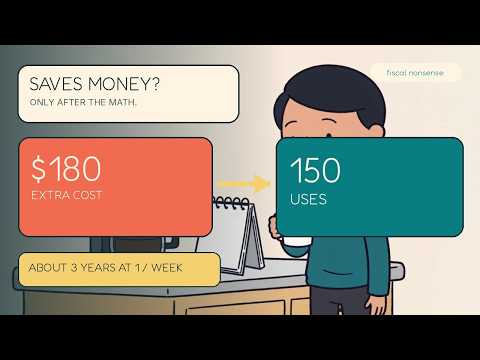
A lower price only saves money when the real saving per use repays the extra upfront cost. See a fictional purchase take nearly three years to break even.