
Your Rent Went Up $200. Is Moving Actually Cheaper?
Your rent rises. A cheaper home appears. Is moving actually the money-saving move—or do the one-time costs swallow the early savings?
 fiscal
Vidéos sur les finances / Budget et épargne
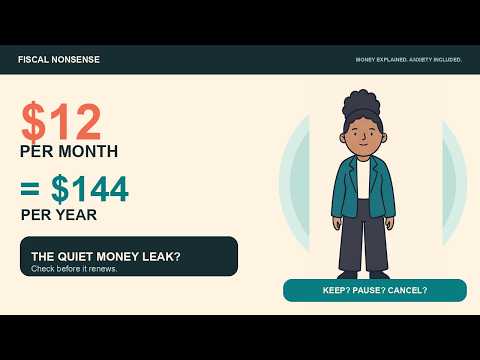
A $12 monthly subscription can be a useful $144 yearly decision. The point is not to cancel everything. It is to see each recurring charge clearly enough to give it a deliberate yes, pause, or no.
Vidéo en anglais
Charger ce lecteur envoie des données de connexion et de visionnage à Google/YouTube, qui peut utiliser des cookies ou technologies similaires. Le reste de la page fonctionne sans lui.
Détails sur la confidentialitéA $12 monthly subscription can be a useful $144 yearly decision. The point is not to cancel everything. It is to see each recurring charge clearly enough to give it a deliberate yes, pause, or no.
In this fictional example, four small subscriptions total $40 a month and $480 across twelve payments. The useful audit asks three questions: what is the exact charge, when is it next due, and what job does it do for you?
YOUR DECISION What is your next subscription-audit action: keep, pause, or cancel? Share the action, not the service or the price.
A SIMPLE AUDIT 1. List the service and exact recurring charge. 2. Add the next charge or renewal date. 3. Name the benefit it is meant to provide. 4. Decide under the provider’s actual terms: keep, pause/downgrade if available, or cancel and retain any confirmation.
FREE TOOL Use the Annual vs monthly subscription calculator: https://fiscalnonsense.com/calculators/subscription-cost/ It compares an annual upfront price with a cancelable monthly plan for 1–12 paid months. It does not identify, cancel, or price subscriptions.
This is general education, not financial, consumer-rights or legal advice. Prices, renewals, cancellations, refunds, taxes and service terms vary by provider and location.
TREND CONTEXT Bank of America Institute reported that U.S. subscription spending rose 7.7% year-on-year in July 2026, using its payments data. This is U.S. context, not a global estimate: https://institute.bankofamerica.com/economic-insights/consumer-subscription-spending.html
Original fictional characters with Callum’s established approved narration, Nina’s approved Celine voice and a native-audio lip-synced Nina scene. Teaching graphics are locally rendered. Final playback is 1.1× with pitch preserved.
Your rent rises. A cheaper home appears. Is moving actually the money-saving move—or do the one-time costs swallow the early savings?
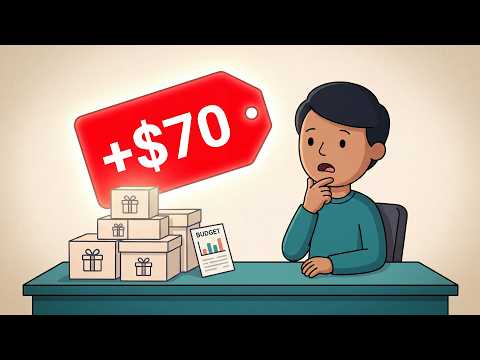
Alex’s fictional $400 holiday plan becomes $470 once food, travel, postage, wrapping and a buffer finally get their own lines.
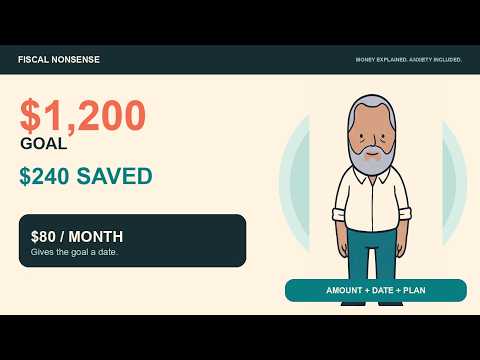
A savings goal becomes a plan when it has four lines: what it is for, the total target, what is already saved, and the date the money is needed.