Comparez intérêts, loyer, entretien, frais de transaction et flexibilité à l’aide d’un exemple chiffré.
Notes et exemples originaux (en anglais)
Alex says renting is paying someone else's mortgage. Ben would like to introduce him to the bank.
Rent or buy? Compare the full cost of housing with Alex, Maya, Leo, Nina and Ben, narrated by Callum. Learn why the monthly mortgage payment, the rent-versus-buy slogan and a universal five-year rule cannot decide for every household.
WHAT YOU WILL LEARN
• Compare similar homes, locations, commuting needs and included services.
• Separate monthly affordability from long-term cost and wealth.
• Distinguish mortgage principal from interest and ownership expenses.
• Account for money tied up in a down payment and the renter's retained savings.
• Include buying, selling and moving costs over your likely stay.
• Stress-test both options and weigh flexibility, control and maintenance work.
CHAPTERS
00:00 The rent myth
00:26 Compare similar homes
01:16 Monthly cash flow versus cost
02:13 The money tied up
02:48 How long are you staying?
03:22 Stress-test renting and buying
04:05 Choose the home and the life
ILLUSTRATIVE MATH — NOT LOCAL PRICE QUOTES
All dollar figures are invented. The monthly example compares similar properties and excludes equal utilities and equal renter extras from BOTH paths.
Rent: $1,500 per month.
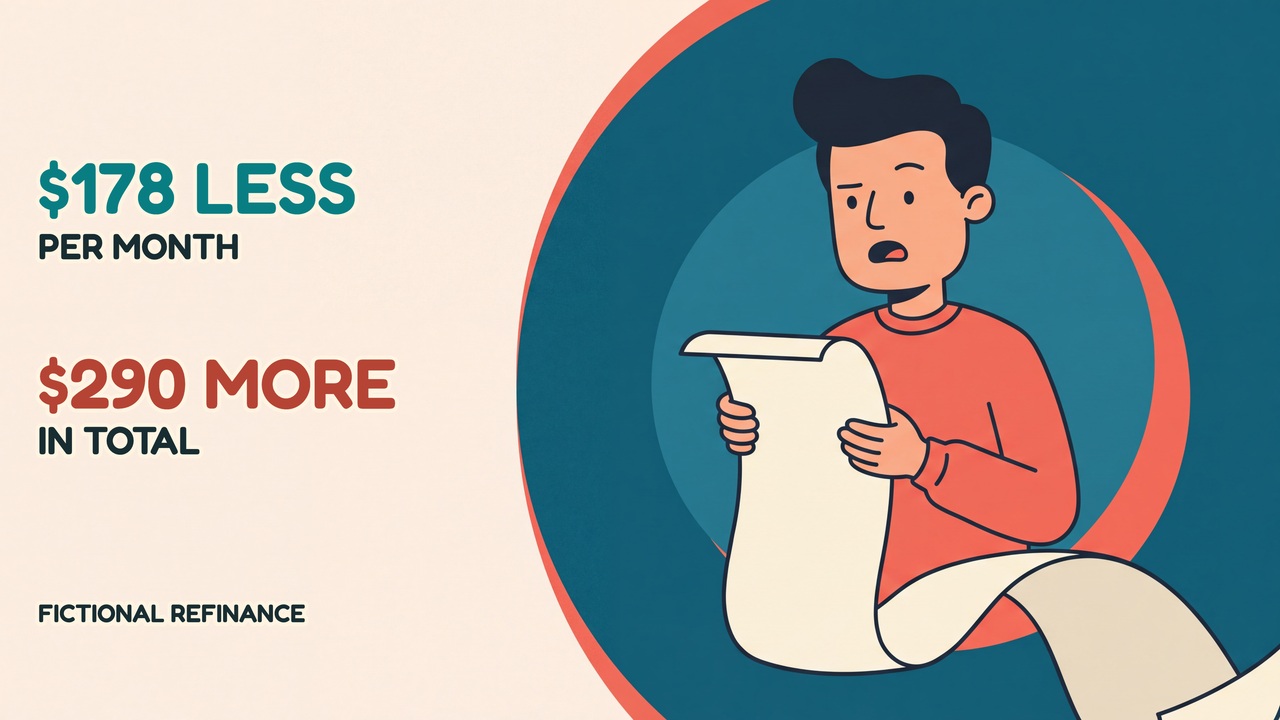
Buying: $1,600 mortgage payment + $400 other owner expenses = $2,000 monthly cash outflow.
Cash-flow gap: $2,000 − $1,500 = $500.
Within that invented mortgage payment, $400 is principal repayment and $1,200 is interest. Principal reduces the mortgage balance. Interest plus the other owner expenses totals $1,600; the other $400 of cash outflow reduces debt. This shows why all cash outflow is not the same as consumed cost.
The $400 owner-expense amount represents incurred or estimated expenses, not extra cash retained in a reserve counted as spent. Do not double-count taxes or insurance already included in another payment. The snapshot omits transaction costs, price changes, tax effects and opportunity cost. It is not a loan quote or a full financial winner calculation. Principal/interest proportions change over time.
Transaction-cost example: $12,000 in combined buying and selling costs divided by 24 months = $500/month; divided by 120 months = $100/month. This is simple averaging with no discounting or changes in other costs. It is NOT a break-even forecast, a recommended holding period or proof that buying wins after ten years.
THE MONEY TIED UP
A down payment generally becomes home equity rather than a fee. It still has an opportunity cost because the money could be used elsewhere. A refundable rental deposit also ties up cash and is not automatically lost; actual deductions and return rules depend on the lease and local law.
Compare the buyer's net equity and other assets with the renter's retained capital and ACTUAL saving/investing over the same horizon. Investment returns are uncertain; renters do not automatically invest every saving. In a net-assets model that already grows alternative investments, do not subtract that same opportunity cost again. At the end, account for the home's value, sale costs, remaining mortgage and relevant taxes.
STRESS-TEST BOTH SIDES
Home prices can fall; repairs and some borrowing costs can rise; selling takes time. Renters face rent increases, lease uncertainty and limits on changes, shaped by local protections. Owners may value control and stability but take on maintenance and concentrated property risk. There is no universal rent/buy winner or magic five-year rule.
Use local quotes and a transparent calculator. Vary the expected stay, early-move scenario, rent growth, mortgage terms, maintenance, price changes, taxes and investment returns. Keep near-term house money appropriately accessible.
Country-neutral general education, not personalized financial advice. Laws, taxes, tenant protections, ownership charges and mortgage structures vary by jurisdiction.
More Fiscal Nonsense: https://fiscalnonsense.com
SOURCES
CFPB — Financial considerations of buying:
https://www.consumerfinance.gov/ask-cfpb/what-are-some-of-the-financial-considerations-of-buying-a-home-en-119/
CFPB — Is it the right time to buy?
https://www.consumerfinance.gov/owning-a-home/prepare/consider-whether-its-the-right-time-for-you-to-buy/
Fidelity — Rent versus buy:
https://www.fidelity.com/viewpoints/personal-finance/rent-vs-buy
Sources discuss their own jurisdictions. Their local thresholds and legal entitlements are not presented as universal.
Original fictional characters. AI-generated voices and character animation; local animated teaching graphics and original sound effects.
#RentOrBuy #HousingCosts #Mortgage #PersonalFinance #FiscalNonsense